
Shree Natnagar Shodh Samsthan
(The Raghubir Library and Research Institute)
(The Raghubir Library and Research Institute)
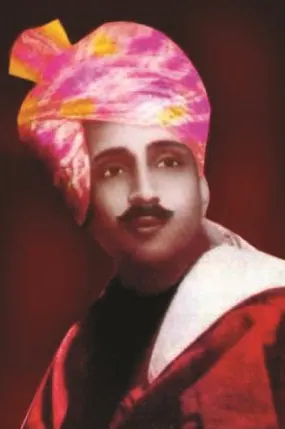
Dr. Raghubir Singh, a visionary leader and the driving force behind our foundation.
Maharaj Kumar Dr. Raghubir Singh was born on 23rd February 1908 at Laduna Palace of Sitamau in the Mandsaur district of Madhya Pradesh. He was the eldest son of Raja Sir Ram Singh, K.C.I.E., the ruler of the former Sitamau State of Central India.
He received his primary education at home and Middle School education at then known as Shri Ram High School, Sitamau. He joined Daly College, Indore in July 1920, but had to leave it owing to illness after a few months. He passed the Matriculation Examination of Bombay University from Baroda High School in 1924 and the Intermediate Examination in 1926, both as a private candidate. Then he taught at Shree Ram High School, Sitamau for two years. He passed the B.A. Examination as a teacher candidate in 1928. Thereafter he joined the Holkar College at Indore and took his LL.B. Degree from Agra University in 1930. He again joined the staff of Shree Ram High School, Sitamau as an honorary teacher and worked there for another three years. He passed the M.A. Examination in History at Agra University in 1933 as a teacher candidate. Then he undertook the D.Litt. research work on the subject “Malwa in Transition 1698-1766”, under the guidance of the great historian Dr. Sir Jadunath Sarkar and received the D. Litt degree from Agra University in 1936. He was the first D.Litt. of that University.
In his school days, he used to bring out a handwritten literary magazine “Kiran” in Hindi and English. It was the budding of his natural talent. His writings in that magazine show that he was developing as a serious writer of essays and prose poems, having his style of writing express suitable emotional nuances evoked by social and national issues. It also shows that, despite his feudal and princely environment, he had already imbibed liberal, nationalist, and democratic ideas, thus laying the foundation of his future growth and build-up.
His advanced liberal and democratic views led him to undertake reformist actions in his state. His father had taken a keen interest in his education and academic development, had great faith in him, and never objected to his progressive views. At a young age, he dreamt of a new progressive Sitamau State leading other princely states of India in constitutional, social, and cultural development.
Soon after passing his LL.B. Examinations in 1930, he was appointed as the High Court Judge of the Sitamau State in 1932, in which post he worked up to August 1940. Along with the judicial work, he was also assigned the responsibility of many other departments of State government, e.g., Revenue, education, police, health, and local self-government in July 1934 and continued to hold charge of these departments till December 1938.
Soon after passing his LL.B. Examinations in 1930, he was appointed as the High Court Judge of the Sitamau State in 1932, in which post he worked up to August 1940. Along with the judicial work, he was also assigned the responsibility of many other departments of State government, e.g., Revenue, education, police, health, and local self-government in July 1934 and continued to hold charge of these departments till December 1938.
To give a concrete shape to his liberal and democratic ideas, Dr. Raghubir Sinh drafted a new constitution of the state, which was inaugurated in December 1938. The constitution marked a fundamental change in the governance of the state by associating the people with the state administration, the constitution provided for the establishment of a state legislature (Rajya Parishad) having a majority of elected members. This constitution continued to be effective till the integration of the state in June 1948. The constitution also provided for the state Executive (Shasan Samiti). He worked as the president of the Shasan Samiti from December 1939 to August 1941 and again from July 1945 to June 1948. He also presided over the State Legislative from May 1939 to August 1941 and again from July 1945 to June 1948. During the period of his administration, he made far-reaching reforms in Primary Education, health development, and rural development activities of the state.
To give a concrete shape to his liberal and democratic ideas, Dr. Raghubir Sinh drafted a new constitution of the state, which was inaugurated in December 1938. The constitution marked a fundamental change in the governance of the state by associating the people with the state administration, the constitution provided for the establishment of a state legislature (Rajya Parishad) having a majority of elected members. This constitution continued to be effective till the integration of the state in June 1948. The constitution also provided for the state Executive (Shasan Samiti). He worked as the president of the Shasan Samiti from December 1939 to August 1941 and again from July 1945 to June 1948. He also presided over the State Legislative from May 1939 to August 1941 and again from July 1945 to June 1948. During the period of his administration, he made far-reaching reforms in Primary Education, health development, and rural development activities of the state.eing held. In October he was sent to the Madras Presidency to observe its sensitive areas, particularly Soinoor and Calicut. He remained there from 18th October 1942 to 10th February 1943. Thereafter he was sent to Juhu (Bombay) for a three-week special training. Soon after this training he was promoted to a Major, then he was again sent to Madras Presidency. He was first posted at Pallavaram and then afterwards at Waltair where he remained till the end of his military career. He resigned his commission and retired from the army in April 1945.
Dr. Raghubir Sinh had been a keen student of politics and constitutional law from his early days. He was closely associated with various activities of the Chamber of Princes ever since 1930 and continued his participation up to its very end. He studied very carefully the problems of Indian States with particular reference to their relationship with the constitutional development of India as a whole including the Indian State as well. He wrote a book on this subject: “The Indian States and the New Regime”, published in 1938, which was used as a textbook on the subject in many Indian universities for several years. He could foresee the coming political changes in India and the imminent withering away of the old political order. Hence he took a keen interest in and worked for the political unification of the States of Malwa region along with others in the adjoining areas during the years 1945-47. He was one of the members of the Central India Region committee appointed in 1946 to unite the small states of Malwa into a collective union. Thus he actively participated in the process of bringing about the formation of the Gwalior-Indore-Malwa (Madhya Bharat) Sangh in 1948.
Dr. Raghubir Sinh was a gifted writer. As has been earlier, he brought out a hand-written magazine in his school days. He began contributing light essays, critical reviews, short stories, and historical narrations from 1927 onwards, which were published in leading Hindi magazines. His initial writings were published in Bal-Sakha and Kshatriya. Later on, his thought-provoking articles, reviews, and stories were published in Saraswati, Sudha, Chand, and Madhuri. As we have seen he worked as a teacher, an administrator a judge, an army officer, a constitutional expert, a negotiator in political affairs, and a public worker of repute. However, he was an academician, yearning for knowledge, searching for truth, and presenting new ideas and plans before the people. His academic performance is visible in all the activities he undertook. He was a man of emotions and he emerged mainly and wholly as a writer. His natural talents are in writing literary pieces and historical articles. He founded the best exposition of his discipleship of the great historian. Dr. Sir Jadunath Sarkar, his association with other eminent historians like G.S. Sirdesai, Prof. Mohd. Habib, K.R. Qanungo. G.H. Ozha, Tarachand, Jaichandra Vidyalankar, P. Saran, H.R. Gupta, Prof. Ganda Singh, Ishwari Prasad, A.L. Srivastava and Prof. Satish Chandra, etc., and his constant correspondence with great Hindi writers like Jaishankar Prasad, Suryakant Tripathi Nirala, Sumitranandan Pant, Hazari Prasad Dwivedi, acharya Ramchandra Shukla, Mahadevi Verma, etc. had greatly molded his ideas and writings. His one article about the French Revolution फ्रांस की राज्य क्रान्ति के कुछ रक्त रंजित पृष्ठ Published in the फाँसी अंक of Chand magazine published in November 1928, reflected his nationalist and revolutionary outlook. The noted Hindi Novelist Acharya Chatursen Shastri, who was the editor of that special issue, wrote about Maharajkumar Dr. Raghubir Sinh “आपकी कलम विद्या व्यसनी ही नहीं बल्कि गरीबों का मित्र क्रान्ति का समर्थक और जन समाज का एक नागरिक प्रमाणित करती है” That issue of Chand was proscribed by the Government. Whereas several prominent writers got their articles published by pseudonyms. However young prince of Sitamau State showed great courage to publish his article in his name.
The publication of Maharajkumar’s article greatly disturbed the British Government authorities and political officers and they made inquiries about the young Prince from the State Government. Thereafter, the British Government remained very suspicious about his views and attitudes. Dr. Raghubir Sinh always aspired to meet and correspond with the patriotic and revolutionary political leaders of India. The well-known revolutionary leader, Thakur Kesari Singh Barhat of Shahpura was in correspondence with him. The Thakur highly appreciated the new constitution of Sitamau State in one of his letters. Maharajkumar attended in 1935 the Indore session of Hindi Sahitya Sammelan and came in touch with Mahatma Gandhi. He was in continuous correspondence with Jaichandra Vidyalankar, the known revolutionary and noted historian of India since 1932. He was closely associated with Jaichandraji in the formation and working of Bharatiya Itihas Parishad, founded in December 1937 in Varanasi. During these years he also came in close touch with Dr. Rajendra Prasad and Kanhaiyalal Maniklal Munshi, at Bharatiya Vidyabhavan Bombay.
His first book was published in 1932. It was “Purva Madhya-Kalin Bharat”, which at once got great appreciation in academic and literary circles and was prescribed as a textbook for Intermediate and B.A. Classes. It was followed by another literary book “Bikhare Phool”, published in 1933.
Malwa in Transition was published in 1938 and its revised Hindi edition “Malwa men Yugantar” was published the next year. His other works are of political and historical value. “Indian States and the New Regime” was also published in 1938. These books were highly acclaimed as a great contribution to historical learning and established him as a leading researcher and historian. “Sapta Deep” another book of literary essays in Hindi was also published in the same year. Thus by 1938, Dr. Raghubir Sinh had already emerged as a rising star on the Indian literary and historical horizon. He was well versed in writing prose poems and his book, which brought him a great reputation and name, was “Shesh-Smritiyan” published in 1939. His prose-poetic writings included in this book were unique for expressions of deep emotions and poetic beauty that touched the heart of every reader. The great Hindi litterateur of the period Pandit Ram Chandra Shukla himself contributed a detailed critical introduction to this book. The book was prescribed as a prose text for the M.A. Examination in many universities. It was translated in Gujarati under the title “Shesh Sambharana”, by Ramnik Meghani.
Malwa in Transition was published in 1938 and its revised Hindi edition “Malwa men Yugantar” was published the next year. His other works are of political and historical value. “Indian States and the New Regime” was also published in 1938. These books were highly acclaimed as a great contribution to historical learning and established him as a leading researcher and historian. “Sapta Deep” another book of literary essays in Hindi was also published in the same year. Thus by 1938, Dr. Raghubir Sinh had already emerged as a rising star on the Indian literary and historical horizon. He was well versed in writing prose poems and his book, which brought him a great reputation and name, was “Shesh-Smritiyan” published in 1939. His prose-poetic writings included in this book were unique for expressions of deep emotions and poetic beauty that touched the heart of every reader. The great Hindi litterateur of the period Pandit Ram Chandra Shukla himself contributed a detailed critical introduction to this book. The book was prescribed as a prose text for the M.A. Examination in many universities. It was translated in Gujarati under the title “Shesh Sambharana”, by Ramnik Meghani.
In 1945, Dr. Raghubir Sinh was awarded “Mangla Prasad Prize” for the year 2003 A.V. by the All India Hindi Sahitya Sammelan of Allahabad for his contribution to Hindi literature on his book “Malwa men Yugantar”
He was associated with the Indian Historical Records Commission as a corresponding member by the Government of India for the period 1937 to 1942. He read many important papers at different sessions. After independence the Government of India nominated him again as a corresponding member of the commission (1952-72) Since 1972 he has been a permanent government nominee on it.
He was entrusted with the great task of editing the Poona Residency Correspondence Series (Vol. IX, X, and Extra Volume) during this period, which was published in 1940, 1943, and 1951.
Dr. Raghubir Sinh was fond of collecting books concerning Hindi and English literature and history. By 1936, he had a large collection of books in his palace at Sitamau. Dr. Sir Jadunath Sarkar inspired him to establish a research library of history and literature. Thus “Raghubir Library” came into existence in 1936. He arranged the books in a separate building. The library gradually developed as a very big and valuable collection of rare printed books, photo prints, and transcripts of micro-film copies of unique and historical manuscripts in Persian Rajasthani, Sanskrit, Hindi, and Marathi languages, particularly relating to Indian history from 13th century A.D. to early 19th century, Sir Jadunath Sarkar described it as an important and most valuable collection not only in Malwa and Rajasthan but in whole of India. Lately, several original collections of old manuscripts and documents have been received from individuals and former Jagirdars. Since 1946 onwards researchers working for Ph.D. or D.Litt. have been coming from various universities and other institutions to utilize the books, manuscripts, and records of the library and receive guidance from Dr. Raghubir Sinh for their work.
After the merger of Sitamau State in the Madhya Pradesh Union in 1948, Dr. Raghubir Sinh’s duties as an administrator came to an end. However, considering his efforts towards the merger of the states in the Indian Union and formation of the Madhya Pradesh Union his experience in the legal, constitutional, and administrative functions, his reputation as a litterateur and historian and his popularity in the people of Madhya Pradesh, Prime Minister Pandit Jawaharlal Nehru got him nominated as the member of the Rajya Sabha on 13th May 1952 which he remained up to 1962. Thus a new responsibility was developed on him. He used all his knowledge and experience to fulfill this responsibility. He took great interest, particularly in Education. Defence, Communications, and cultural affairs.
He always actively participated in the debate of the House providing relevant information to the members and giving his suggestions on various issues. As he had been a Commissioned officer in the Indian Army, he closely knew various problems facing the formation of the new Indian Army, Conditions in the Army Cantonments, and the army personnel. He asked questions about arrangements being made for the Indian armies, which had come to India leaving their previous establishments in Pakistan, about the use of various previous cantonments in India, about the establishment of new cantonments given new defense arrangments of the country, about the replacement of the old techniques of warfare by new scientific techniques.
As an eminent historian, Dr. Raghubir Sinh showed keen interest in the writing of the history of the freedom struggle in India and rewriting of Indian History factually with a clear Indian perspective. He particularly took great pains in raising the problem of protection and preservation of the old cultural and archaeological wealth of the country. He, time and again, emphasized the need to give full attention to preserving old monuments, temples, buildings, and other works of art, which were getting ruined day by day. He made suggestions for proper amendments to the Act and for preparing a complete national list of all available monuments and works of Art of historical and archaeological importance in the country. Participating in the debate in this regard he informed the House that many of the monuments mentioned by Col. James Tod in his book “Annals and Antiquities of Rajasthan” and “Travels in Western India” are not visible now as the authorities have been indifferent towards their value and they have been destroyed. He mentioned the case of the monuments of Chandravati, near Abu, and how they have been carelessly destroyed to lay a railway line. He asked the government to take immediate and concrete steps to save such monuments of international importance as Khajuraho. Mandu, Sanchi, Vidisha, Hinglajgarh, etc.
Similarly, Dr. Raghubir Sinh drew the attention of the government to give due importance to the development of the Hindi language and its use at the central level. He asked the Finance Minister to prepare his budget in Hindi. He also emphasized that state government should use their provincial languages as the medium of instruction and in the work of all government offices. He also took a keen interest in the speedy development of the railway, for laying more lines, increasing speed, converting several meter gauge lines into broad gauge, and improving the facilities being provided to the passengers. He also emphasized the electrification of railways. As early as 1955-56, he emphasized the need for a railway line between Kota and Chittor, which has recently been opened. Similarly, he suggested making the Five-year plan more flexible, including the Chambal Pariyojana into the Five-year plan, to take firm actions to prevent adulteration in food articles and to protect and enrich the National Laboratories of the country.
Dr. Raghubir Sinh was appointed as a parliamentary adviser to the Indian delegation to participate in the 11th session of the United Nations General Assembly in November 1956 and represented India on the 4th and 5th committees. Prominent members of the delegation were V.K. Krishna Menon, G.S. Pathak, and Arthur S. Lal. He actively participated in the discussions of the delegation. At the request of the Teachers College, Columbia University Department of History, he visited the college on 4th December 1956 and delivered a lecture there on the political and social conditions of India and gave satisfactory replies to the questions raised by the audience.
In 1954 Maharajkumar prepared a scheme for the reorganisation of the state of Madhya Bharat, elucidating its problems and presenting their possible solutions. He submitted it as a memorandum of 50 pages to the States Reorganisation Commission of India in 1954. He proposed the creation of the New State of Malwa, in which he excluded the Gwalior region and included some parts of Rajasthan State. The scheme was completed in detail with a map showing the boundaries of the proposed new state.
As has been mentioned above, Maharajkumar Dr. Raghubir Sinh emerged as a literary writer and historian in the thirties and got great prominence in the forties. After independence, he got more time to devote himself much more to his literary and historical research work. His two literary works in Hindi Jeevan Dhuli and Jeevan Kan were published in 1949 and 1950 respectively.
His two historical works of great value Ratlam ka Pratham Rajya and Poorva Adhunik Rajasthan were published in 1951. The first contains a history of the Rathor princely families of Malwa during the 17th century based on new research and the second contains a brief but detailed survey of historical events and changes in Rajasthan during 1527-1949. It was the first attempt to write a general history of Rajasthan, not state and ruler-wise, but in a combined and period-wise system. It received high appreciation from academic circles with the hope that attempts would be made to adopt this method in writing future historic. He translated J.N. Sarkar’s famous book “A Short History of Aurangzeb” into Hindi and got it published for Hindi readers. In 1949, he prepared a list of important historical manuscripts preserved in the Raghubir Library, Sitamau, and got it published for the information of historical researchers throughout the country and abroad to enable them to make use of the preserved research material in the Library for their projects.
Since the Fifties, Maharajkumar began devoting mainly to historical research work and gradually ceased writing literary essays in Hindi. However, he continued enriching the Hindi language by writing his historical articles and books mainly in Hindi language in his own lucid and attractive literary style. His style gave a new dimension to historical writing, which remained no more a dry and uninteresting reading but became attractive and absorbing for the readers.
He contributed research articles to various historical journals of the country bringing out new facts and information and presenting new analysis and interpretation of the historical events. His every article used to become a source of discussion in academic circles and the letter always aspired to read his next writing. In 1973 his short book on “Maharana Pratap” was published and a book on “Durgadas Rathor” in 1975 both in his inimitable style.
In 1979 his book on Rajasthan historiography “Rajasthan ke Pramukh Itihaskar aur Unka Krititva” was published. He rewrote the biography of Rana Pratap, analyzing Rana’s character and role in a new light. The book “Maharana Pratap: Jeevani, Mahatva aur Den” was published in 1983. In 1984 he published in English “The Julusi Sanehas of the Mughal Emperors of India (1556-1857 A.D.)” His edited books on Shivaji and Aurangzeb in Hindi were published in 1985. His edited work on the records of Malwa concerning the Great Indian Rebellion of 1857-1858 – “Malwa ke Mahan Vidroh Kalin Abhilekh” was published in 1986.
As described earlier, he edited English records of Maratha History in 3 volumes with the title “poona Residency correspondence”, which were published in 1940, 1943, and 1951 respectively.
Dr. J.N. Sarkar and Dr. Raghubir Sinh Jointly edited the work “Shivaji’s visit to Aurangzeb at Agra” based on Rajasthani records, which was published in 1963 Dr. Raghubir Sinh in joint co-operation with Dr. Satish Chandra and Dr. G.D. Sharma edited “Jodhpur Hukumat ri Bahi” and published the work in 1972 with the title “Marwar under Jaswant Singh (1658-1678)”. His edited work “Fort William India House Correspondence (1786-88)” was published in 1973. He revised and edited Sir Jadhunath Sarkar’s book “A History of Jaipur”, which was published in 1984. He also edited Hindi records in the Peshwa Daftar and got the work entitled “Selections from the Peshwa Daftar” published in 1979 and his other work concerning sources of Maratha history “Maratha Rajya Sambandhi Abhilekh” was published in 1982.
His other edited important works include “Vachanika Rathor Ratan Singhji Ri” (p. 1960), Kavi Kalanidhi Shri Krishna Bhatta Virachit-Sambhar Yudha (p. 1969), Shah Jahan Nama Munshi Devi Prasad Krit (P. 1975), Ajit Granth (p. 1978, Shyamaldas Krit Veer Vinod (p. 1986), Shridhar Krit Jangnama (p. 1986), Jodhpur Rajya ki Khyat (p. 1988).
Maharajkumar Dr. Raghubir Sinh’s valuable contribution to the Hindi language and literature and historical research and learning received due recognition from various institutions and organizations and he was duly honored by them. As mentioned earlier, he was awarded Mangla Prasad Puraskar in 1945, by Hindi Sahitya Sammelan, Allahabad. In February 1954, he was given a prize by the U.P. Government for his book “Poorva Adhunik Rajasthan”. In December 1975, Hindi Sahitya Sammelan, Allahabad honored him by conferring him the honorary degree, “Sahitya Vachaspati”. In 1978, U.P. Hindi Samsthan, Lucknow especially honored him and presented a special prize of Rs. 15,000/- for his lifelong services to the Hindi language and literature. Dr. Raghubir Sinh presided over the Gwalior session of Madhya Pradesh Hindi Sahitya Sammelan in April 1976.
Dr. Raghubir Sinh presided over the Local History Section and Mughal History section of the Indian History Congress at Gwalior in December 1952 and at Waltair in December 1953 respectively. He presided over the Annual Session of Madhya Pradesh Itihas Parishad held at Jabalpur in December 1974. He presided over the Chaupasani (Jodhpur) session of the Rajasthan History Congress in March 1979.
Dr. Raghubir Sinh’s valuable honorary services and assistance were acquired by government bodies and other institutions from time to time. He worked as Chairman of, the Madhya Bharat Regional Records Survey Committee between 1953 and 1956 and then continued working in that capacity since 1968. He worked as a member of the Madhya Pradesh State Advisory Board for the revision of the District Gazetteers since 1958. He had been a Trustee of the All India Kashiraj Trust, Fort Ramnagar, district Varanasi since 1957. He was a Fellow of the Royal Asiatic Society London for life. He was a life member of the following bodies – the Asiatic Society of Bengal, Calcutta, the Asiatic Society, Bombay, the Calcutta Historical Society, Calcutta, P.E.N. India, Bombay, Nagari Pracharani Sabha, Varanasi and Indian History Congress. He remained a member of Madhya Pradesh Itihas Parishad, Bhopal, and Rajasthan History Congress, Jaipur.
His name, figured in various national and international biographical listings and who’s who, etc., of which the mains are –
The greatest achievement of Dr. Raghubir Sinh’s life was the founding of the research institute – “Shri Natnagar Shodh Samsthan, Sitamau on 14th August 1974.
Since its foundation, Sansthan has conducted and completed several valuable research projects under his supervision and a few of them have been published which are very useful for the researchers. His greater emphasis had been to provide more and more source material to the researchers by editing and publishing the original material available in Sansthan’s Library.
Maharajkumar Dr. Raghubir Sinh breathed his last on Feb. 13, 1991, in his simple room adjoining the Library at Sitamau. He had a fracture in the leg on August 3, 1989, and also suffered from urine trouble. For about 18 months, he remained bedridden suffering from acute pain.
Maharajkumar always abhorred a luxurious and easygoing life. Despite being a prince, he kept away from all ostentations of the royal life. He disliked ostension and pretension. He liked to lead a simple life from his early years. As he came into contact with the great persons in the political and literary field, he developed modern ideas of nationalism, patriotism, and revolution and feelings of renunciation and sacrifice. At an early age, he made up his mind to work for the awakening and upliftment of his country. Consequently, he devoted his entire life to attaining that object working in the political field but mainly through literary and historical writings. When his father Raja Sir Ram Singh died in 1967 he voluntarily stepped aside in favour of his elder son Raja Krishna Sinh Rathore.
By nature, he was very hard-working and never wasted time on useless chores. He had a charming, unassuming, and pleasing personality. Till the end, he led almost a saintly life living in a simple room with very few necessities. He wore simple Khadi clothes and ate simple food. Indeed he was a saintly prince. In the academic circles of the country, he was known as the Princely Historian.

DR. Raghubir Sinh Marg, Sitamau,
Dist Mandsaur (M.P.)
shreenatnagar@yahoo.co.in, info@natnagar.org
07426-222910
(The Raghubir Library and Research Institute)
DR. Raghubir Sinh Marg, Sitamau,
Dist Mandsaur (M.P.)